When scientists become the subject of research: MARVEL through the lens of the social sciences
By Nicola Nosengo - EPFL
MARVEL researchers are accustomed to examining complex phenomena—whether through sophisticated instruments or advanced computational models. Occasionally, however, scientists themselves become the object of investigation. This was the case for MARVEL, which was selected as one of the Swiss research centres and consortia studied by the INTERSECTIONS project.
Launched in 2022 and funded by the Swiss National Science Foundation (SNSF) through its PRIMA programme, INTERSECTIONS (Investigating Interdisciplinarity and Transdisciplinarity: Intersections of Practices, Culture(s) and Policy in Collaborative Knowledge Production) explores how interdisciplinary and transdisciplinary research is shaped by the interaction of research practices, knowledge cultures, and institutional policies. Its overarching goal is to strengthen collaborative research so that it can better address complex societal challenges.
While interdisciplinary research—bringing together researchers from different scientific disciplines—and transdisciplinary research, which also involves non-academic stakeholders, are widely encouraged, they often face structural obstacles. Funding mechanisms, governance arrangements, and research assessment systems can unintentionally hinder collaboration across disciplinary and institutional boundaries. INTERSECTIONS seeks to identify these barriers and develop conceptual and practical approaches to better support boundary-crossing research.
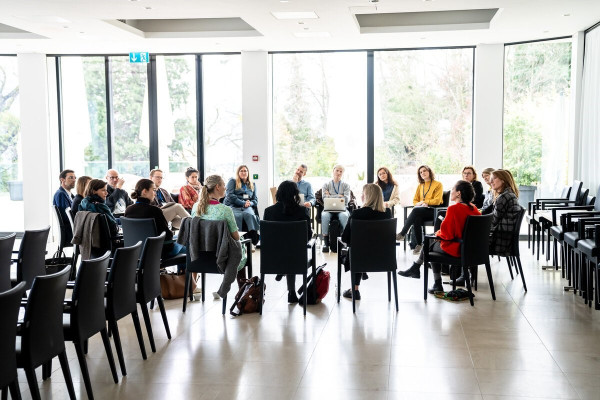
Among the doctoral projects funded within INTERSECTIONS, Helena Winiger's doctoral research at ETH Zurich, supervised by PD Dr Bianca Vienni-Baptista (both part of the Transdisciplinarity Lab, ETH Zurich), focuses on MARVEL as a case study of interdisciplinary and transdisciplinary research in the field of emerging technologies. Her work investigates how institutional norms, governance processes, and organisational practices shape collaborative research.
© Swiss National Science Foundation
The study combines a literature review with qualitative research methods, including interviews, focus groups, and multi-sited ethnographic fieldwork across Swiss research centres working on emerging technologies. The aim is also to provide an empirically grounded contribution to science policy and funding strategies supporting interdisciplinary and transdisciplinary research in Switzerland and beyond.
MARVEL played a prominent role in the study, providing an in-depth view of how interdisciplinary collaboration unfolds in practice. Although the research is still ongoing, preliminary findings have already emerged. Winiger’s study suggests that interdisciplinary collaboration does not develop automatically: without deliberate institutional support, even collaboration between theoretical and experimental traditions within the same discipline remains relatively uncommon.
At a broader institutional level, the study finds that Switzerland's National Centres of Competence in Research (NCCR) programme provides valuable long-term structures that support interdisciplinary research. However, interdisciplinary and transdisciplinary research are still challenged by disciplinary structures and established norms of organizational practice can hinder societal engagement in research and development. The research also points to a limited integration of critical disciplinary perspectives in the governance of emerging technologies and suggests that collaboration itself is still insufficiently recognised and rewarded as a core scientific value.
The results of Helena Winiger's research will be presented in an upcoming scientific publication.