MARVEL Junior Seminar - May 2026
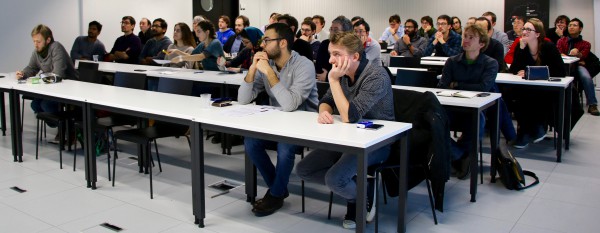
Each seminar consists of two presentations of 25 minutes each, allowing to present on a scientific question in depth, followed by time for discussion. The discussion is facilitated and timed by the chair.
Pizzas will be served after the seminars in order to facilitate discussions based on the talks just presented.
Onsite participation
12:15 — Seminars take place in EPFL room Coviz2 (MED 2 1124)
~13:15 — Pizzas will be served in the MED building atrium, second floor
Online participation
Starting at 12:15:
https://epfl.zoom.us/j/66062713727
Password: 43
Abstracts
Talk 1 — Quantification of Ecut Discretization Error in Plane-Wave Density Functional Theory
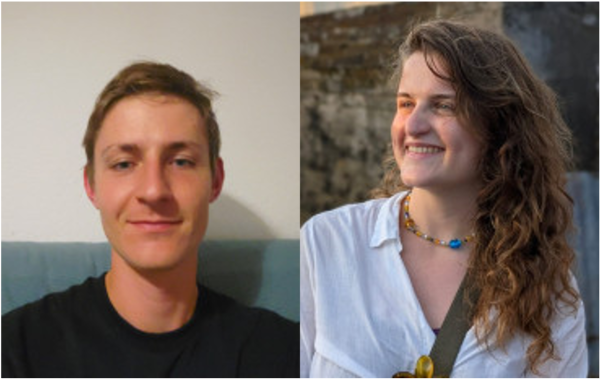
Bruno Ploumhans, Michael Herbst
Mathematics for materials modelling (MatMat), EPFL
Plane waves truncated at a so-called kinetic energy cutoff Ecut, are the standard basis set for density functional theory computations in materials. In this talk, I follow up on promising recent developments by Cancès et al. [1], who proposed an estimate for the discretization error due to the choice of the kinetic energy cutoff. I will review the method, and present a strategy to choose its key numerical parameters, with the goal of turning these error estimates into a routinely applicable technique. Then, I will present a benchmark on an extended set of systems, showing that the discretization error is estimated well at reasonable cost, and that Ecut recommendations from pseudopotential tables should be used with caution.
[1] E. Cancès, G. Dusson, G. Kemlin, and A. Levitt. "Practical error bounds for properties in plane-wave electronic structure calculations", SIAM Journal on Scientific Computing 44, B1312 (2022)
Talk 2 — Physics-Based Molecular Representations for the Classification of Organocatalysts
Sofia Petrova, Clémence Corminboeuf
Computational Molecular Design Laboratory (LCMD), EPFL
Organocatalysts have emerged as powerful, metal-free alternatives for asymmetric synthesis, yet navigating their vast and structurally diverse chemical space remains a significant challenge. Here we ask whether physics-based 3D molecular representations can automatically distinguish organocatalysts from drug-like molecules, and whether the resulting embeddings carry chemically meaningful information about catalyst identity. Using a curated dataset of 7,768 molecules drawn from the OSCAR organocatalyst benchmark and DrugBank, we benchmark five molecular representations across two classifiers and show that SLATM achieves 99% binary classification accuracy. We then go beyond classification to ask what SLATM actually learns: unsupervised clustering of the embeddings recovers known catalyst motif families and exposes structural convergence zones where catalysts and drugs are genuinely inseparable. Together, these results suggest that physics-based geometry encodes mechanistic chemical identity and point toward a generalizable framework for ML-driven catalyst discovery.