MARVEL Junior Seminar — February 2026
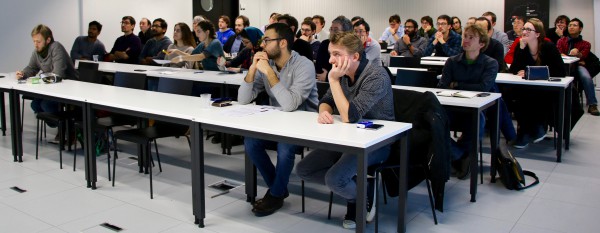
Each seminar consists of two presentations of 25 minutes each, allowing to present on a scientific question in depth, followed by time for discussion. The discussion is facilitated and timed by the chair.
Pizzas will be served after the seminars in order to facilitate discussions based on the talks just presented.
Onsite participation
12:15 — Seminars take place in EPFL room Coviz2 (MED 2 1124)
~13:15 — Pizzas will be served in the MED building atrium, second floor
Online participation
Starting at 12:15:
https://epfl.zoom.us/j/67590343532
Password: 275492
Abstracts
Talk 1 — Databases of Fermi surfaces and de Haas-van Alphen oscillation frequencies from first principles simulations
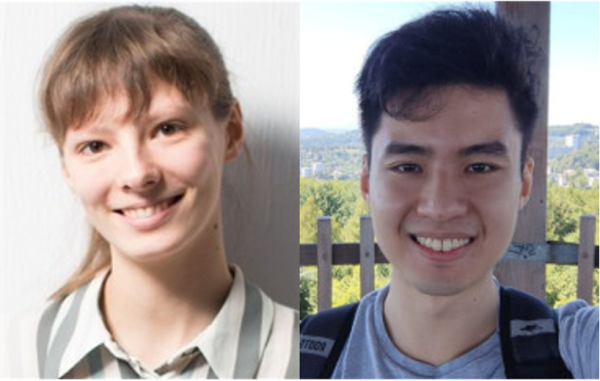
Nataliya Paulish, Junfeng Qiao, Giovanni Pizzi
Materials Software and Data Group, PSI
The Fermi surface (FS) of a metal separates occupied from unoccupied electronic states and governs its low-energy electronic properties. In particular, FS nesting, when large portions of FS are connected by a common translation wavevector, promotes electronic instabilities. Computing FS requires dense Brillouin zone sampling, but direct density functional theory (DFT) calculations are limited by computational cost. Here, we use interpolation from a basis of spatially localized projectability disentangled Wannier functions (PDWFs), a recent fully automated Wannierization algorithm [1, 2], to efficiently compute FSs for over 7'000 inorganic metals from the Materials Cloud MC3D database [3] (https://mc3d.materialscloud.org). For each FS, we compute de Haas-van Alphen frequencies, enabling direct comparison with experiments. We are extending the simulation workflow to support FS nesting factor and bare dynamic susceptibility calculations. Simulations are fully automated using the AiiDA workflow engine [4], ensuring FAIR data principles. Results will be made openly available in the MC3D database.
[1] J. Qiao et al., npj Comput Mater 9, 208 (2023)
[2] Y. Jiang et al., npj Comput Mater 11, 353 (2025)
[3] S. P. Huber et al., arXiv:2508.19223 (2025)
[4] S. P. Huber et al., Scientific data 7, 1 (2020)
Talk 2 — Towards a Universal Machine Learning Model for the Electronic Density of States
Wei Bin How, Michele Ceriotti
Laboratory of Computational Science and Modelling - COSMO, EPFL
Universal models have made remarkable progress, but most efforts center around machine learning interatomic potentials (MLIPs), overlooking other properties. In this talk, I will provide some background and complexities regarding learning the electronic density of states and introduce PET-MAD-DOS, a universal model for the electronic density of states (DOS) developed in COSMO. This model is built on the highly expressive point edge transformer (PET) architecture and is trained on
the massive atomistic diversity (MAD) dataset. The predictive abilities of PET-MAD-DOS on both the DOS and its derived quantities are evaluated on the MAD dataset and other external diverse datasets. Furthermore, we apply PET-MAD-DOS to three industrially relevant systems: lithium thiophosphate (LiPS), gallium arsenide (GaAs), and high entropy alloy (HEA). We compare its performance against bespoke PET models trained on specific systems, on both the DOS and ensemble-average quantities and show that PET-MAD-DOS is able to provide performance comparable to that of bespoke models. Additionally, we also introduce fine-tuning as a practical strategy to achieve strong performance on specific systems whilst retaining universal generalizability, using only a fraction of the data.
Check the list of the next MARVEL Junior Seminars here.