
Watching heat flow through diamond nanobeams: theorists team up with experimentalists
By Nicola Nosengo/NCCR MARVEL
Experimental and theoretical condensed-matter physicists and materials scientists have joined forces to explain and measure – with spatial resolution below a micrometer - how heat is transported in diamond nanostructures, highlighting an unexpected dependence of the heat flow on the size of the diamond structure.
Thanks to its unique heat transport properties, diamond finds more and more applications in advanced technologies like high-power and ultrafast electronics, nonlinear optics, quantum sensing, and quantum nanophotonics. But making an accurate description of how heat flows in it at the nanoscale is challenging for both theorists and experimentalists. For theorists, the problem is that in carbon-based materials like diamond (as well as graphene and graphite), heat can travel in a nondiffusive way, which is quite different from the more common diffusive transport seen in other materials. For experimentalists, a huge challenge is finding sensors that can measure temperature changes on sufficiently small scales and with high accuracy.
A new article in Physical Review Letters addresses both challenges, starting with an elegant solution to the experimental problem. Scientists in Christophe Galland’s group at EPFL fabricated long suspended diamond cantilevers with a triangular section less than a micrometer in width. They designed small metal patches on their tips to apply heat with a focused laser beam. Then, to measure the resulting temperature profile, they scanned a second laser across the cantilever to excite negatively charged nitrogen vacancy (NV) centers, which are luminescent defects in the diamond, introduced here on purpose during the material synthesis. Their spin resonance frequency is temperature- dependent, so NVs can be used as optically addressable nano-thermometers. This makes it possible to image temperature variations inside the device and to study heat transport in nanostructures with unprecedented detail.
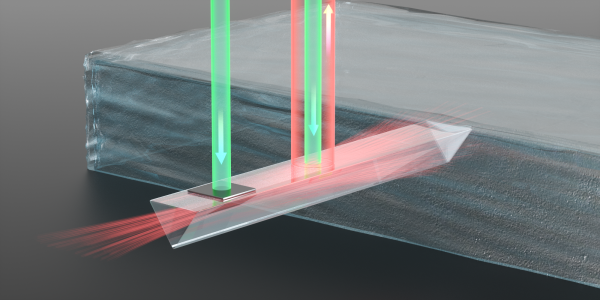
Artistic representation of the diamond cantilever used for the experiments.
Reference
Goblot, V., Wu, K., Di Lucente, E., Zhu, Y., Losero, E., Jobert, Q., Jaramillo Concha, C., Quack, N., Marzari, N., Simoncelli, M., Galland, C., Imaging Heat Transport in Suspended Diamond Nanostructures with Integrated Spin Defect Thermometers, Phys. Rev. Lett. 136, 12, 2026, doi: https://doi.org/10.1103/3s96-7ghm