Expert panels gives the European Commission a roadmap for materials innovation
From energy storage to drug delivery, from computing to manufacturing, advanced materials will be essential for the economy of the future. But how can Europe lead their development instead of just being an adopter of technologies developed elsewhere?
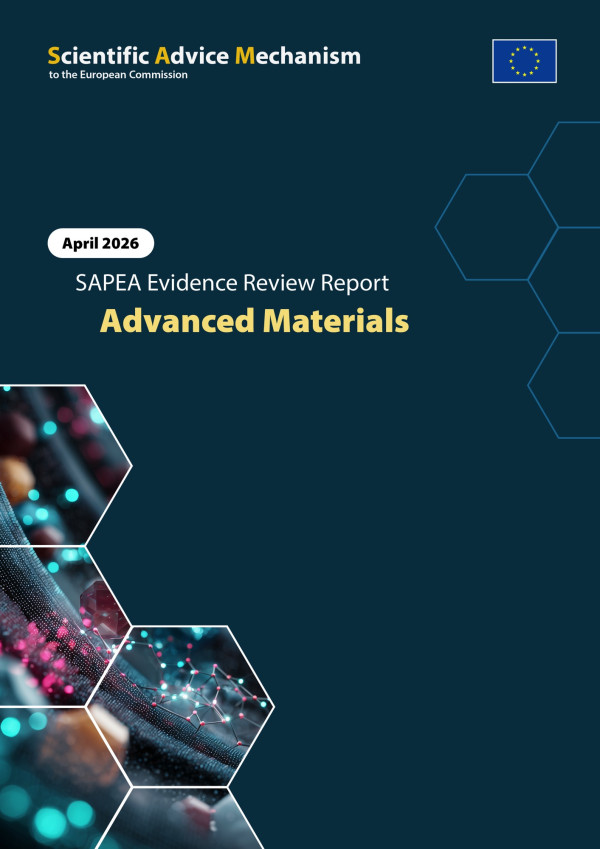
That was the existential question that the European Commissioner for Startups, Research and Innovation Ekaterina Zaharieva asked to the Group of Chief Scientific Advisors (GCSA) of the European Commission. The group, whose role is to provide timely and independent scientific advice to Commissioners, convened 22 experts in materials science nominated by academies of science and engineering across Europe. Between June and December 2025, the working group – that included NCCR MARVEL Director Nicola Marzari – reviewed and compiled the latest evidence on the subject and produced an evidence review report that the GCSA used to prepare its Scientific Opinion. Both documents have been formally handed to Zaharieva on 21 April.
Notably, Prof. Dr. Anke Weidenkaff, Co-chair of the SAPEA working group, Stressed that "Europe leads in computational modelling and first-principles simulation codes, yet lacks the high-quality, specialised datasets needed for AI-driven discovery of more sustainable materials. Additionally, Europe's fragmented cross-border economic ecosystems weaken its ability to compete with concentrated advanced materials manufacturing hubs elsewhere".
The experts acknowledge that, despite Europe’s strong foundation in science and regulatory practices, structural challenges hinder the process from materials discovery to their safe, sustainable, and competitive use. These include the fragmentation of R&I ecosystems, the gap between EU and US or Asian private investment in this area, low levels of digitalisation in the design and development of advanced materials, insufficient industrial support for inventors to cross the “valley of death”, and a lack of the necessary skills for the future.
The main recommendations that the Scientific Advisors drew from the evidence report are that the EU should:
- Harness computational and data-driven methodologies so that AI, Digital Twins, and self-driving labs can accelerate discovery, improve early risk screening, and ensure that the resulting materials, products, and processes are safe and sustainable.
- Use Europe's comparative advantage in standards and digital product passports to create clear, performance-based rules and transparent information flows that reward durable, reparable, low-toxicity materials and could make high-quality European products a global benchmark.
- Turn successful research into marketable products, coordinating infrastructures, partnerships, procurement and circular business models, and helping ensure that promising materials move rapidly into sustainable, certifiable production systems.
- Reinforce Europe's long-term capacity in blue-sky research and human capital, while also securing access to critical raw materials and affordable green energy, in a more coherent research and innovation (R&I) funding landscape.
Among the authors of the evidence review report, MARVEL director Nicola Marzari was the co-leader of a chapter on data, simulations and AI. The chapter highlights that when it comes to materials design and exploration of new properties, simulation-driven or data-driven approaches, or a combination of the two truly accelerate materials discovery. Importantly, Europe is a leader in simulations, particularly in first-principles modelling, and computational workflows and codes generated by European scientists are used worldwide. Simulations not only can predict accurately materials properties and suggest novel avenues for testing and development, but provide the extensive and diverse data sets that AI/ML need, and that can then be applied to design entirely new materials with desired properties. In fact, integrating AI/ML approaches into advanced materials discovery had remained challenging due to limited high-quality data, and only the advent of massive first-principles datasets has changed radically these capabilities. While existing databases support new research, there is an additional need of highly specialised datasets to advance target domains, or the nascent field of autonomous laboratories and self-driving labs to accelerate material synthesis, manufacturing, and characterisation while leveraging advanced AI models.
The key messages of the chapter are:
- First-principle data-driven approaches and AI are becoming instrumental in designing new advanced materials.
- High-quality databases built on FAIR principles are critical to employing AI and simulations in materials discovery. In addition, these databases should incorporate digital profiles of materials for specific applications and industrial use.
- There is a need for improved data mining and curation to create and strengthen reliable data pipelines.
- AI can enable next-generation digital twins and self-driven labs that will scale advanced materials discovery and manufacture at previously unattainable levels and identify new sustainable materials.
Marzari mentions that “the recognition of European leadership in first-principles simulations is very rewarding, as is the pressing need to generate high-quality computational datasets and train novel foundational models. It is also personally reassuring to see that this was the very forward-looking agenda that MARVEL initiated with its proposal and actions, from 2012 onwards”.
Marzari was also a co-author of the Materials Science chapter of the PRACE (Partnership for Advanced Computing in Europe) Scientific and Innovation Case for Computing in Europe 2026-2034. It is the 4th edition of this publication from PRACE as the Association of Users and HPC Centres. Each chapter focusses on a different scientific domain, showing the variety in methodologies and hardware used. From those domain-specific analyses, a set of cross-domain recommendations for scientific and political decision-makers is derived. The report, published on 29 April, stresses that simulation capabilities, workflows and data are the frontiers for HPC in materials, and gives some key recommendations to enable AI- and HPC- driven materials discovery, from supporting a heterogenous HPC ecosystem to giving both academia and industry broad access to infrastructures, AI models and data.